
Reimagining collective effectiveness
The For Good domain plays an increasingly important role in addressing complex social, environmental, and economic challenges. However, it often lacks the shared structures, coordination mechanisms, and evidence bases found in other parts of the economy.
With this challenge in mind, how might we reimagine how diverse actors coordinate, share evidence, and align resources to produce reliably greater public value at scale?
Research phase objectives
The research phase examines how the For Good domain can better organise to deliver public value at scale through greater collaboration, capacity building, and innovation. We aim to learn directly from practitioners, policymakers, funders, researchers, and intermediaries to understand where and why collective effectiveness is constrained.
Research objectives include:
- Establishing the analytical boundaries of the For Good domain, adopting capital flows (including public, private, philanthropic, and corporate) that are discretionary and explicitly allocated, governed, and used to achieve mission‑oriented public outcomes—where benefits are structurally diffuse.
- Comparing the Third and Fourth sectors as two distinct but valid economic models for public value creation,
Across the For Good domain, validate common coordination challenges, structural constraints, and where value is lost through fragmentation, such as missing or under-resourced functions.
These objectives prioritise inquiry and the development of evidence and data over advocacy.
Lines of enquiry
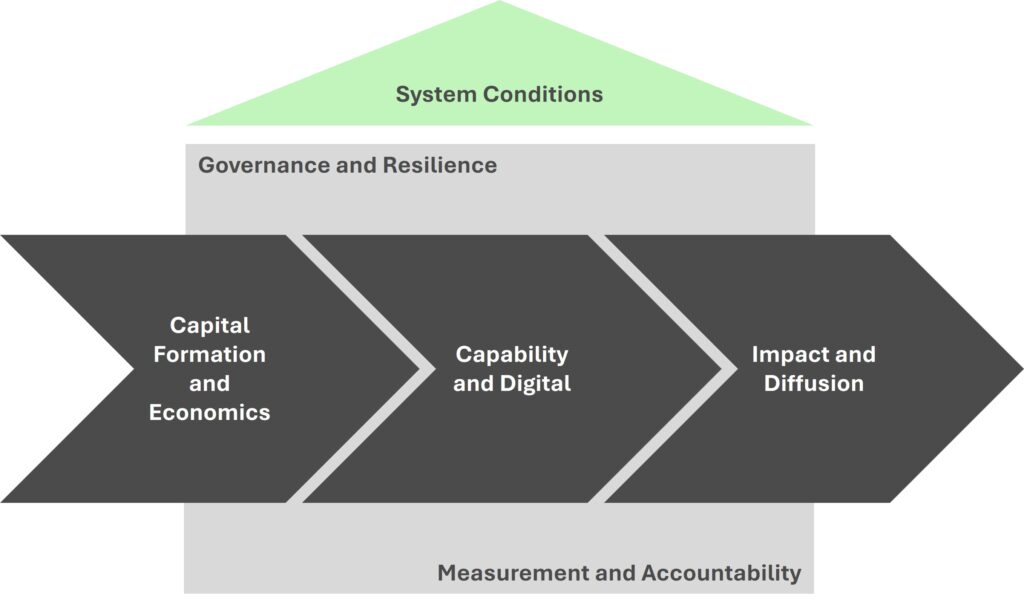
The research is currently examining two primary lines of enquiry:
- How is capital allocated and transformed into mission‑oriented public outcomes?
- Capital and economics — How and why is capital formed and allocated? Which funding instrument best addresses the hardest-to-fund risks?
- Capability and digital — How do people, processes, and technologies transform capital into outcomes? Which capabilities most constrain effectiveness?
- Impact and diffusion — What is the biggest barrier to spreading proven methods?
- How is capital governed and protected?
- System conditions — Which policies, standards, intermediaries, and networks influence how capital is used? Which rule or shared standard would most unlock coordination and capital?
- Governance and resilience — What are the risks to mission protection? What mechanism most reliably prevents mission drift under financial pressure?
- Measurement and accountability — What evidence, indicators, and stewardship exist? Which outcomes meaningfully express public value in context, and how should they be balanced?
Research approach
The research will employ hybrid methods, including:
- Semi-structured interviews with leaders and practitioners across the domain,
- Quantitative surveys with organisations,
- Synthesis of recurring themes and patterns using a theory of systems change framework, and
- Open sharing of emerging insights for critique and refinement.
This approach is lightweight and adaptive. Its aim is to identify meaningful patterns rather than produce formal evaluations or policy recommendations.
All engagement will follow informed consent, anonymisation, data and privacy standards and laws. Identifiable information will only be published with explicit consent.
What comes next
The research is currently focused on establishing the analytical boundaries. We will publish our working analytical boundaries as an early research note to invite critique and refinement.
As part of the multi-year research phase, we will publish regular updates, which will include new case studies, emerging insights, patterns, and analyses on the Resources page.
Subject to ethical review, practitioner consent, and transparent validation, one potential outcome of this research is the development of a multi-modal artificial intelligence (AI) model that integrates natural language processing (NLP). This model aims to provide sector-specific, real-time guidance for social innovators through a cloud-based advisory platform. You can learn more about our use of AI in our Responsible Use of AI Statement.
The research findings and feedback from practitioners in the field will inform any future proposals for such resources.
Ways to engage
The research phase is open-ended and focused on public learning.
Future proposals will be shaped by the evidence gathered here.
If you work in or alongside the For Good domain and have suggestions, you are welcome to contribute.